Thursday, September 27, 2007

Donate to Equal Access Abortion Fund, Get Autographed Book!


The Equal Access Fund of East Tennessee believes that the right to choose abortion is meaningless without access to abortion services. Restrictions to access and funding are discriminatory because they especially burden poor women, young women and women of color.

EAF of Tennessee was created for the following purposes:

* to provide direct financial assistance to low income women & girls who wish to terminate an unwanted pregnancy, but can't raise the funds to obtain a safe and legal abortion, and to dispense these funds in an equitable manner

* to raise public awareness of the devastating impact of denying access to safe and legal abortion services

* to support ongoing efforts to restore public funding of abortion in conjunction with The National Network of Abortion Funds

* * * * * * * * *

Katha Pollitt, award winning progressive author and dedicated feminist/activist, has shown her dedication to the EAF cause once more.

She has not only sent in a donation, but also agreed to send an autographed copy of her new book, Learning to Drive: And Other Life Stories, to anyone who donates $100 or more to EAF this week.

Read yesterday's case below.

----------------------------------------------------------------------------------------

To my dependable group of pro-choice activists,

I thank you for all your help in the past. Unfortunately, our work is never done and I have a case this morning that is very timely. Please contact me back by email if you can help the case featured below. - Heather of Equal Access Fund


From my mailbox this morning:

"I had to turn away a very nice, very desperate couple this morning who are going to Atlanta this Friday for a 2 day procedure because she is almost in her 20th week. We didn't charge her for the ultrasound because money is an issue; the money they are putting together is for their living expenses and will wind up with their being evicted I'm afraid. I've given her several numbers to call or emails to send and made several calls on her behalf and am hoping for the best. She is doing a lot of footwork on her own, and bless her heart is trying everything she can to keep her spirits up. I thought the two of them were going to pass out when they learned how far along she was and they tried so hard to be so brave and adult. (edited to remove personal info) ... and they are going to be staying with her mom, who has her own set of problems apparently. She's a good kid and seems to be trying to do her best not to repeat the mistakes of the generation before her if you get my drift. Anyhow, I just wanted you to know who was contacting you and why if you do hear from her. Thanks for all you do for our patients and I hope this finds both of you doing well. Rena, KCRH "

and from the patient:

"my name is xxxxx, and i went to the knoxville center for reproductive health today in the hopes to have an abortion there, but i am too far along and have to go to atlanta this friday and saturday to have the procedure done. i am 21 and not ready in any way shape or form to be a mother. i am a hostess at a restaurant and enrolled at pellissippi state and i am in dire desperate need of any monetary help i can get. my boyfriend and i are working as hard as we can and are doing everything in our power to get through this point in our lives. knoxville center gave me a list of options for some possible help. my phone number is xxxxxxx if you could contact me as soon as possible given i am pressed for time. i appreciate anything you all can do for me, and greatly respect what you are doing for women like me. god bless. "

I wrote the patient to see how much it will take to solve her current woes and here is the response:

"i have an appointment at summit medical center in atlanta on friday the 28th continuing through saturday being that it will be a two day procedure. the total cost will be $1325. i have gotten $100 from the south mountain women's alliance, and with that i have about $400-500 between cash and a discover card. a woman affiliated with the south mountain women's alliance is offering $50 to help pay for my hotel room friday night. in case you'd like to contact me, my number is xxxxxx. thank you for your help and concern, it is greatly appreciated ."

My question to my email list of activists is this:

Could you donate today?

Thanks,

Heather Robinson
Equal Access Fund

Verizon Reverses Itself on Abortion Rights Messages


September 27, 2007
Verizon Reverses Itself on Abortion Rights Messages
By ADAM LIPTAK
New York Times

Saying it had the right to block “controversial or unsavory” text messages, Verizon Wireless last week rejected a request from Naral Pro-Choice America, the abortion rights group, to make Verizon’s mobile network available for a text-message program.

But the company reversed course this morning, saying it had made a mistake.

“The decision to not allow text messaging on an important, though sensitive, public policy issue was incorrect, and we have fixed the process that led to this isolated incident,” Jeffrey Nelson, a company spokesman, said in a statement.

“It was an incorrect interpretation of a dusty internal policy,” Mr. Nelson said. “That policy, developed before text messaging protections such as spam filters adequately protected customers from unwanted messages, was designed to ward against communications such as anonymous hate messaging and adult materials sent to children.”

Mr. Nelson noted that text messaging is “harnessed by organizations and individuals communicating their diverse opinions about issues and topics” and said Verizon has “great respect for this free flow of ideas.”

The other leading wireless carriers had accepted the Naral program, which allows people to sign up for text messages from Naral by sending a message to a five-digit number known as a short code.

Text messaging is a growing political tool in the United States and a dominant one abroad, and such sign-up programs are used by many political candidates and advocacy groups to send updates to supporters.

But legal experts said private companies like Verizon probably have the legal right to decide which messages to carry. The laws that forbid common carriers from interfering with voice transmissions on ordinary phone lines do not apply to text messages.

In reversing course today, Verizon did not disclaim the power to block messages it deemed inappropriate.

The dispute over the Naral messages was a skirmish in the larger battle over the question of “net neutrality” — whether carriers or Internet service providers should have a voice in the content they provide to customers.

“This is right at the heart of the problem,” said Susan Crawford, a visiting professor at the University of Michigan law school, referring to the treatment of text messages. “The fact that wireless companies can choose to discriminate is very troubling.”

In initially turning down the program, Verizon, one of the nation’s two largest wireless carriers, had told Naral that it does not accept programs from any group “that seeks to promote an agenda or distribute content that, in its discretion, may be seen as controversial or unsavory to any of our users.” Naral provided copies of its communications with Verizon to The New York Times.

Nancy Keenan, Naral’s president, said Verizon’s initial decision interfered with political speech and activism.

“No company should be allowed to censor the message we want to send to people who have asked us to send it to them,” Ms. Keenan said. “Regardless of people’s political views, Verizon customers should decide what action to take on their phones. Why does Verizon get to make that choice for them?”

On Wednesday, Mr. Nelson, the Verizon spokesman, said the initial decision had turned on the subject matter of the messages and not on Naral’s position on abortion. “Our internal policy is in fact neutral on the position,” Mr. Nelson said. “It is the topic itself” — abortion — “that has been on our list.”

Naral provided an example of a recent text message that it has sent to supporters: “End Bush’s global gag rule against birth control for world’s poorest women! Call Congress. (202) 224-3121. Thnx! Naral Text4Choice.”

Messages urging political action are generally thought to be at the heart of what the First Amendment protects. But the First Amendment limits government power, not that of private companies like Verizon.

In rejecting the Naral program, Verizon appeared to be acting against its economic interests. It would have received a small fee to set up the program and additional fees for messages sent and received.

Text messaging programs based on five- and six-digit short codes are a popular way to receive updates on news, sports, weather and entertainment. Several of the leading Democratic presidential candidates have used them, as have the Republican National Committee, Save Darfur and Amnesty International.

Most of the candidates and advocacy groups that use text message programs are liberal, which may reflect the demographics of the technology’s users and developers. A spokeswoman for the National Right to Life Committee, which is in some ways Naral’s anti-abortion counterpart, said, for instance, that it has not dabbled in text messaging.

Texting has proved to be an extraordinarily effective political tool. According to a study released this month by researchers at Princeton and the University of Michigan, young people who received text messages reminding them to vote in November 2006 were more likely to go to the polls. The cost per vote generated, the study said, was much smaller than other sorts of get-out-the-vote efforts.

Around the world, the phenomenon is even bigger.

“Even as dramatic as the adoption of text messaging for political communication has been in the United States, we’ve been quite slow compared to the rest of the world,” said James E. Katz, the director of the Center for Mobile Communication Studies at Rutgers University. “It’s important in political campaigns and political protests, and it has affected the outcomes of elections.”

Timothy Wu, a law professor at Columbia, said it was possible to find analogies to Verizon’s decision abroad. “Another entity that controls mass text messages is the Chinese government,” Professor Wu said.

Jed Alpert, the chief executive officer of Mobile Commons, which says it is the largest provider of mobile services to political and advocacy groups, including Naral, said he had never seen a decision like Verizon’s.

“This is something we haven’t encountered before, that is very surprising and that we’re concerned about,” Mr. Alpert said.

Professor Wu pointed to a historical analogy. In the 19th century, he said, Western Union, the telegraph company, engaged in discrimination, based on the political views of people who sought to send telegrams. “One of the eventual reactions was the common carrier rule,” Professor Wu said, which required telegraph and then phone companies to accept communications from all speakers on all topics.

Some scholars said such a rule was not needed for text messages because market competition was sufficient to ensure robust political debate.

“Instead of having the government get in the game of regulating who can carry what, I would get in the game of promoting as many options as possible,” said Christopher S. Yoo, a law professor at the University of Pennsylvania. “You might find text-messaging companies competing on their openness policies.”

Wednesday, September 26, 2007

Across the Deep South, religion, culture and politics collide to make ‘abortion’ a dirty word


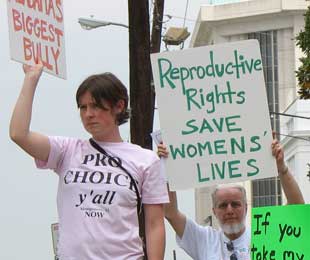
Pro-choice demonstration at the Alabama State House in April 2006

In These Times
Features > September 26, 2007
An Unholy Alliance
By Carrie Kilman
Click here for article link

Every Wednesday and Friday morning, two or three volunteers wearing bright green shirts that read “Pro-Choice, Y’all” assemble in front of Reproductive Health Services in Montgomery, Ala., to escort patients from the parking lot to the front door, past a small sea of anti-abortion protesters.

The protesters carry handmade signs and pictures of fetuses sucking their thumbs. They play violins and blow loudly into horns. They thrust graphic pamphlets at the patients, form prayer circles on the sidewalk, and teach their children to plead with women to not murder their babies. The protesters are mostly women. They look like Sunday school teachers, housewives and hip grandmas. And, during the past few months, they have grown more vocal and more organized, emboldened by the recent closure of the only clinic in Mobile.

Every state in the Deep South—Alabama, Georgia, Louisiana, Mississippi and South Carolina—restricts low-income women’s access to abortion. Most ban abortion after 12 weeks of pregnancy. None explicitly protect heath care facilities from harassment or violence. All have mandatory delay laws that unfairly burden women who have limited access to transportation and time off work, and Louisiana and South Carolina both passed unconstitutional laws requiring a husband’s consent for a married woman’s abortion. In the past 16 months, two abortion clinics in Alabama have closed, and new regulations are making it difficult for other clinics to stay open. Now, anti-abortion groups are strategizing ways to outlaw birth control and eliminate sex education.

Michelle Colon, president of the National Organization for Women’s (NOW) Mid-South region (Alabama, Arkansas, Louisiana, Mississippi and Tennessee) calls it a “war on women”—the gravity of which citizens in more progressive parts of the country don’t appreciate. “The rest of the country kind of writes off the South—people feel the battle has been lost here,” Colon says.

Colon is part of a vocal, scrappy cadre of grassroots activists challenging the well-funded, entrenched anti-abortion movement that has long dominated state legislatures and local pulpits across the region. One Southern feminist put it this way: “Women here are sick and tired of being sick and tired.”

“It’s not legal, is it?”

Every morning when June Ayers arrives for work, she scans the parking lot for suspicious people and packages before getting out of her car. Ayers owns Reproductive Health Services, one of seven clinics that provide abortions in Alabama. She’s been followed home, trailed at the mall and harassed on her front porch.

Ayers was close friends with David Gunn, a doctor who performed abortions at clinics throughout Alabama and Florida. Anti-abortion protesters plastered Gunn’s face and home phone number to “Wanted” posters and distributed them at rallies. He answered their harassment by blasting Tom Petty’s “I Won’t Back Down”, singing along, and wagging his finger in their direction. In March 1993, Gunn died when a protester shot him three times in the back outside of his clinic in Pensacola, Fla. The doctor on Ayers’ staff now wears a bulletproof vest.

Ayers recently invested in a sprinkler system to keep the protesters at bay. She has also installed concrete stepping-stones across the lawn so patients and escorts can avoid the protesters crowding the sidewalk. She bought orange vests for the escorts, so startled patients can distinguish between protesters and volunteers.

“At least once a month, I have women who call me and ask whether abortion is legal. That type of misinformation is rampant,” says Ayers. “We’re in the middle of the Bible Belt. It’s not just religion, it’s the fanatical religious aspect that keeps stirring people up who are opposed to us.”

It’s a place where the Christian Coalition holds sway over politicians, and many people vote the way they’re told in church. The legislative climate is “very hostile” toward abortion, says Felicia Brown Williams, who oversees Planned Parenthood’s advocacy agenda in Mississippi, one of two states with only one abortion clinic.

Mississippi has passed so many laws governing what abortion clinics can and cannot do that it is virtually impossible to open a second clinic without breaking state law. Mississippi requires permission from both parents for women under 18, except in cases of incest. The state’s conscience clause allows pharmacists to refuse to fill prescriptions for birth control. And earlier this year the Mississippi legislature passed a “trigger law,” immediately making abortion illegal should Roe v. Wade be overturned.

From ‘pro choice’ to ‘reproductive justice’

In the early-1990s, researcher Loretta Ross noticed the anti-abortion movement was borrowing tactics from the Ku Klux Klan—things like “Wanted” posters and targeted bombings. Ross now directs SisterSong, a national reproductive health collective in Atlanta. She travels the country, encouraging groups like Planned Parenthood to adopt a philosophy that SisterSong terms “reproductive justice.”

“Stopping at the right to terminate a pregnancy is woefully inadequate when it comes to the realities of people of color,” Ross says. “We have to fight for three different dimensions of the struggle: We join our pro-choice sisters to fight for the right not to have a child; but as women of color, we have been subjected to various strategies of population control, like forced sterilization, so we also have to fight for the right to have a child, especially in the context of people accusing us of having babies to get on welfare or to stay in the country. And we have to fight for the right to parent the children we already have, thanks to a criminal justice system that’s trying to capture them earlier and earlier.”

Moving from “pro-choice” to “reproductive justice” may prove crucial in the Deep South—home to a fast-growing Latino population—and towns like Montgomery, Ala., which is about 50 percent black.

“There is an unholy alliance between the legislators who oppose civil rights and the legislators who oppose reproductive rights,” Ross says. “As long as we look at reproductive rights only as the politics of gender, we will be missing the guiding script.”

Each year, Operation Save America (OSA) targets different clinics across the United States. Last summer, the group traveled to Jackson, Miss., for a weeklong “siege” to temporarily shut down the state’s only abortion clinic. OSA members, who compare themselves to Martin Luther King Jr., liken abortion to black genocide and lynching. While the anti-abortion movement has made inroads with some black churches, OSA’s references to lynching and Rev. King went too far.

Jackson’s abortion rights community mobilized to protect the last clinic in Mississippi. With volunteers coming from as far as Canada, they organized a door-knocking campaign, traversing Jackson’s communities of color and poor white communities, educating residents about OSA.

Abortion rights supporters from across the South flooded Jackson that week, in a series of counter-rallies and speak-outs called Reproductive Freedom Summer. OSA’s tactics—burning a Gay Pride flag and pages of the Koran, and picketing two Christian churches—created a local uproar. The clinic stayed open.

So goes the nation

Other states, like New York or Wisconsin, have achieved a kind of equilibrium, with a mass of vocal supporters on both sides. Outside of cities like Atlanta, this isn’t true of the Deep South.

“People are afraid to be seen at pro-choice events for fear of losing their jobs, or being rejected from church, or their kids being ostracized at school,” says Colon, of Mid-South NOW. In some places in the South, abortion is referred to as the “A word”; and many women, upon arriving for an abortion, tell clinic staff they think abortion is wrong.

“Most of the time, women think they actually deserve the ridicule and harassment from the street protesters,” says Ayers, from the Montgomery clinic. “It’s self-punishment: ‘I deserve to be accosted, because this is the choice I’m making.’”

Last year, Deirdra Harris Glover realized her silence implied tacit approval of Mississippi’s proposed abortion ban. So Glover, an admitted “professional geek,” launched ProChoiceMississippi.org to encourage closeted abortion rights supporters to come out. “Shame is an incredibly dehumanizing tactic used by the anti-abortion movement,” Glover wrote in an email. “They’ve managed to paint abortion as too awful to ever be dragged into the light of day.”

The Deep South’s reproductive rights community has few political allies. In Mississippi and Louisiana, Democrats run on anti-choice platforms. “We don’t have any judges on our side. We don’t have many in the media on our side,” says Colon. “The pro-choice allies in the state legislature are the older black men. The women in the legislature sell us out every time.”

And yet thinking that anti-choice zealotry is only an issue south of the Mason-Dixon line is a mistake. Laws restricting women’s access to healthcare have chipped away at abortion rights in almost every state. In fact, only seven states have laws protecting the right to an abortion.

“In some ways, the South is behind; but in some ways, the South is dictating the rest of the country,” says Ross, of SisterSong. “There wouldn’t be a resurgent right-wing if the rest of the country wasn’t becoming Dixie-fied.”

Colon adds: “If we lose the South, the middle of the country won’t be long.”

Tuesday, September 25, 2007

Poland loses ruling in abortion case

Last Updated: 25/09/2007 12:17
Poland loses ruling in abortion case
article

The European Court of Human Rights today confirmed Poland will have to pay compensation to a woman who nearly went blind after being denied an abortion under strict Polish laws.

Poland had appealed an order by the Strasbourg-based court in March to pay the woman €39,000. Judges rejected that appeal yesterday, a court spokesman said this afternoon.

The verdict in March enraged the conservative government of Prime Minister Jaroslaw Kaczynski. The ruling coalition has been pushing for a total ban on abortion in the predominantly Roman Catholic country, which already has one of the strictest abortion laws in the European Union.

Polish law allows a pregnancy to be terminated only when it threatens the life or health of the mother, when the baby is likely to be permanently handicapped or when it originates from rape.

In March, the European based court ruled that Alicja Tysiac, whose eyesight worsened after the baby girl was born and who is now registered as disabled, had been denied her human rights under Poland's anti-abortion laws.

Ms Tysiac, who is bringing up three children alone, suffers from an eye disease and cannot see objects more than 1.50 metres away. She receives a monthly disability pension equivalent to €140.

Ms Tysiac became pregnant in 2000. Three doctors told her she could go blind if she gave birth to her third child, but they refused to write her a certificate that would authorise an abortion.

Monday, September 24, 2007

Why women face agonizing waits for abortions in Ottawa


By Jenn Gearey, The Ottawa Citizen
Published: Monday, September 24, 2007
click here for article

*******

PHOTO: Morgentaler Clinic counsellor Samantha Wood says she refers four or five women a day to Montreal or Toronto to get abortions, where the wait is much shorter.
Julie Oliver, the Ottawa Citizen

*******

In less than five minutes, Jennifer will be called in from the Morgentaler Clinic's waiting room to have an abortion. It can't happen soon enough for her: She's been waiting six weeks, watching her belly grow and feeling her hormones go berserk.

Twenty-year-old Jennifer is 13 weeks pregnant. She's been on a waiting list to have an abortion since the end of July and by now it's Sept. 11.

"The wait has been extremely straining on me and those around me," says Jennifer, moments away from the procedure. "I couldn't believe I had to wait so long. ... I became so anxious and impatient about my situation."

Jennifer, who did not wish to have her real name used in this story, is one of thousands of Ottawa women every year who believed that if they needed an abortion they could get one on demand. It's a wake-up call when they find out otherwise.

Canadians for Choice, an Ottawa-based non-profit organization that tracks the accessibility of abortion, says women in Ottawa face the longest wait times in the country for the procedure.

The average wait for abortion in Canada is an estimated two weeks, the group says. And in Toronto, a woman can usually have the procedure within about eight days. The average wait time in Ottawa is generally at least four weeks.

Patricia Larue, executive director of Canadians for Choice, says that in contrast to Ottawa, she can count at least 11 places in Toronto and 11 in Montreal where abortion is accessible -- and some clinics on a full-time basis. In Ottawa, abortion is only offered at the Bank Street Morgentaler Clinic and The Ottawa Hospital -- two days and one day a week, respectively.

Shayna Hodson, spokeswoman for the Morgentaler Clinic in Toronto, says Ottawa has a different history than Toronto on this issue.

"Looking at the history of Ottawa, it was more difficult to set up abortion facilities there than in Toronto -- there were more petitions," Ms. Hodson says. "But it's not because of a lack of will from doctors or lack of demand. The thing is, the subject is still very much taboo, so you're not going to have droves of women rallying about this because who wants to be the woman publicly saying 'I want an abortion'?"

Ms. Larue says the six-week wait time that Ottawa women encountered this summer was too long.

"By the time a woman knows she's pregnant, makes a decision on what she wants to do, and finds out where to go to get an abortion, sometimes it's too late," she says, explaining that some women have to carry their unwanted pregnancies to term as a result.

Ms. Larue says at The Ottawa Hospital, the time limit to have an abortion is 18 weeks gestation; 17 at the Morgentaler Clinic. And, she says, most doctors in Canada won't perform abortions beyond 22 weeks.

"Abortion law in Canada is unique," says Ms. Larue. "Here, abortion is a decision that's made between a woman and her doctor. There are no restrictions whatsoever. It's up to the clinic or hospital to say at what point they won't give them anymore, and at what point the doctor feels it's unethical for them."

Since some women don't have the luxury of time for a six-week waiting list, Samantha Wood, telephone counsellor at the Morgentaler Clinic, says she refers women to Montreal or Toronto, where the wait is considerably shorter.

"I would say I refer four or five patients a day to different clinics, but there's no way of knowing whether they actually follow up with them," says Ms. Wood. "To be quite frank, I think it's somewhat inhumane to make women wait -- the physical and emotional effects are unnecessary."

Ms. Wood, 22, had the procedure herself in 2005 in her second year of university. She was fortunate that she didn't have to wait as long as many others.

"I always knew what my choice would be if I became pregnant, but I was pretty naive of how the system worked before I got into the situation myself," she says. "I was extremely lucky. I only waited 20 days back then. A couple of weeks ago, the wait was the worst I've ever seen. People get pretty upset."

Summer months and just after Christmas are the worst times to need an abortion in Ottawa.

"The reason wait times go up in the summer is because the hospital's centre closes down for a month in August and they don't do any (abortions) at all during that time -- but the need is always constant," says Ms. Larue. "After Christmas isn't as bad because they only close for two weeks."

One Ottawa abortion doctor, who asked to remain anonymous to prevent harassment and threats, explained some of the dynamics of having an abortion at The Ottawa Hospital's Women's Health Centre. Women who opt to go there, she said, are sent to the hospital's birthing ward for a pre-abortion ultrasound, where they sit with expectant mothers and posters that read "Congratulations on Your Baby."

The Ottawa doctor says there are better alternatives, but she feels proper access to abortion is being ignored.

"Abortion just doesn't get any attention anymore; people think it's solved and not an issue," she says.

She says that with only two abortion clinics operating part-time in Ottawa, the city is still expected to perform abortions for women from the Valley, Belleville, and even Kingston to some extent, since there are no doctors there who are able to perform abortions over 14 weeks -- Ottawa takes in women from Nunavut for the same reason.

"After 12 to 14 weeks, the procedure changes," says Ms. Larue. "So a GP wouldn't be able to do it anymore, they'd need to have surgical training."

Overall, abortion actually appears to be on the decline in Canada, although only slightly. In 2003, the most recent year for which statistics are available, 103,768 abortions were performed in Canada, down almost 1,500 from 2002 and down 2,500 from 2001.

But in Ottawa, abortion doctors and facilitators say they are frustrated that they can't provide the abortion services they say women need.

Since The Ottawa Hospital independently decides how many abortions its doctors will perform every year, the issue rests with its board. A spokeswoman for the hospital said board members would not comment on that decision-making process.

In the case of the Morgentaler Clinic, it's up to the Ontario government to decide how many abortions it can perform -- based on the funds it's willing to give the clinic.

"Every year I apply for more money and every year I get a letter saying I'll get exactly the same amount as I did the year before," says Joan Wright, manager of Ottawa's Morgentaler Clinic, who said she wishes the clinic could operate on more than a part-time basis.

A.G. Klei, spokesman for the Ontario Ministry for Health and Long-Term Care, says the ministry provided enough money for the clinic to perform 2,350 abortions this year.

"Last year, the Morgentaler Clinic requested increased funding for its services that was not approved at the time, but they can continue to request in the future," says Mr. Klei.

But while additional funding for an existing abortion clinic has been turned down for the Morgentaler Clinic, the ministry says there's another reason behind why there are so few clinics in the Ottawa area.

"There have been no other applications to the ministry from interested groups wanting to obtain an abortion clinic licence in Ottawa," says Mr. Klei.

Ms. Hodson says she can't understand why the ministry would consider funding new abortion clinics, but not increase funds for an existing one to deal with the shortage of abortion services in the city.

"Why not expand the existing clinic, which has a great reputation, an excellent safety record, already established infrastructure and overhead, rather than spend taxpayers' money on a new one? It's all circular talk when you break it down."

Ms. Wright is also skeptical.

"If you ask the government for more money for abortion you get kicked," she says. "Health care is dying and (Dalton) McGuinty isn't going to 'up' the money for abortion -- that would have people screaming. And the government certainly doesn't want that during an election ... so it falls between the cracks."

When asked about lengthy abortion wait times in Ottawa, Ben Chin, spokesman for the Ontario Liberal Party, says the party's focus is on hospital lineups: for cardiac procedures, cancer, MRI/CTs, hip and knee surgery, and cataract procedures. He also said the party would work toward wait-time progress for emergency room visits, children's surgery and general surgery. There is no mention of abortion in his response.

When asked the same question, Mike Van Soelen, spokesman for Ontario Progressive Conservative leader John Tory, also responds without mentioning abortion.

"It's shocking that Ottawa is lagging behind provincial wait time averages in many areas--everything from hip replacement to cataract surgery," says Mr. Van Soelen. "Ottawa is the province's second largest city and the premier's home town. Health care has to do better."

As it is, there is no shorter wait time in sight for abortion in Ottawa. And there appear to be several other factors that contribute to that.

"A lot of doctors who fought along with Dr. Morgentaler are now retired and there simply aren't as many people doing abortions now," says Ms. Larue. "These days it's hard for medical students to get access to learn how to do the procedure. Often, they have to fight for it."

To reduce wait times for abortion procedures and accommodate more women, Ms. Wright suggests that in the future an alternative may be drug-induced abortions, which can be done in a general practitioner's office. Surgical abortion is the dominant method of abortion in Ottawa and Ms. Larue says that only one doctor in the city performs drug-induced abortions.

Abortion doctors in Ottawa, meanwhile, aren't optimistic for the future.

With a deteriorating health care system, they recognize that abortion surgery is not on a high-priority list, which leaves women like Jennifer no choice but to wait through an unwanted pregnancy for sometimes months, trying to ignore the physical and emotional signs that just won't go away.

© The Ottawa Citizen 2007

Debate continues over rights of incarcerated women in Missouri to obtain an abortion

Appeals court hears Mo. case on inmate abortions
By CHERYL WITTENAUER
Associated Press Writer
click here for article

ST. LOUIS --Security concerns and the state's limited resources outweigh female offenders' right to abortion, the state argued Monday in defense of a policy against transporting them to an abortion clinic outside of prison.

Missouri's two-year-old policy, since declared unconstitutional by a federal district judge in Kansas City, is reasonable and constitutional, Assistant Attorney General Michael Pritchett told a federal appeals court panel here.

Incarceration by definition means inmates are denied certain freedoms, including "the right to procreate, vote, and travel," he said.

The American Civil Liberties Union disagreed, arguing that the state has exaggerated its security concerns and in fact, has shown it can transport offenders without incident to an abortion clinic in St. Louis despite the presence of protesters.

ACLU attorney Diana Kasdan said the state devotes more resources and security measures to accommodate the far larger number of female offenders who carry their pregnancies full term.

Women, no matter what, have a constitutional right to abortion, she said, noting that a handful of courts considering the question have ruled in favor of incarcerated women seeking abortion.

Pritchett argued that an accomplice could take advantage of frequent protests at the St. Louis abortion clinic to free an offender seeking an abortion. But Kasdan said the protesters are relatively few and aren't allowed onto the clinic's parking lot. The clinic provides a separate entrance and waiting room for offenders, and a correctional officer is permitted in the procedure room, she said.

Judge William Riley asked who pays for the care of female offenders who carry their pregnancies to term. "Does that make a difference?" he asked.

Pritchett said the state pays a flat contractual rate to a private vendor to provide health care to inmates, including obstetrics care.

The state used to pay to transport an inmate for an abortion, though not the procedure itself, but the policy was reversed in July 2005.

The state Department of Corrections cited costs, security concerns and a 1986 state law prohibiting the use of public funds, facilities and employees to assist an abortion when it's not necessary to save the life of the woman.

Under the revised policy, the department would only transport an inmate for an abortion if her life or health were endangered.

U.S. District Court Judge Dean Whipple ordered the state to transport a pregnant inmate - referred to in court as Jane Roe - to receive an abortion in October 2005, and the U.S. Supreme Court declined to intervene.

The case was certified as a class action, leading to Whipple's ruling last year ordering Missouri to take pregnant inmates to abortion clinics when they request the procedure.

A three-judge panel of the Eighth U.S. Circuit Court of Appeals heard arguments in the case Monday on appeal from Attorney General Jay Nixon.

Since September 2006, the state has transported three offenders to obtain an abortion. The state has transported a total of seven to abortion clinics since June 2005, the Department of Corrections said.

By contrast, from July 2006 to this past July, 52 female offenders - all at the women's prison in Vandalia - delivered babies at area hospitals.

Most children born to offenders end up living with other family members, Corrections spokesman Brian Hauswirth said. Missouri has no program to accommodate offenders and their children in prison, even for overnight visits, he said.

Zambia stalls on legalizing abortion; calls for more "discussion" on the issue

Zambia: 'State Will Let People Debate On Abortion Before It Acts'
The Times of Zambia (Ndola)
NEWS
24 September 2007
link to article

GOVERNMENT will only recommend whether or not to fully legalise abortion as demanded by some health experts after the issue is exhaustively debated by members of the public, chief Government spokesperson, Mike Mulongoti, has said.

Mr Mulongoti said in an interview in Lusaka yesterday that the Government would not rush into taking a position on the highly controversial issue because the matter was still being debated.

"We cannot make any recommendations on abortion now since medical and ethical experts are still debating. Let them continue debating. As Government we shall only come in at an appropriate time if need arises," Mr Mulongoti said.

He said the Government would have to go back to Parliament to amend the existing Act on abortion if members of the public strongly felt that there was need to fully legalise abortion.

Mr Mulongoti, who is Information and Broadcasting Services Minister, said Zambia had strict laws, which were still in force and could not be thrown out without following the right procedure.

Health Deputy Minister, Lwipa Puma, however, warned in an interview yesterday that legalising abortion in Zambia would mean lawlessness and would promote unsafe sex leading to increased numbers of HIV/Aids as women would be aborting freely.

Dr Puma advised those making such recommendations to consider the repercussions if the Government went ahead. He also advised stakeholders to include tradition leaders in their debates to be aware of the dangers of unsafe abortions.

University Teaching Hospital (UTH) experts in obstetrics and gynaecology last week blamed Zambia's high maternal mortality rate on illegal abortions conducted illegally by unqualified people and appealed to the Government to fully legalise it to curb such deaths.

The experts said 30 per cent of the maternal deaths at the UTH were a result of unsafe abortion and called on the Government to legalise it so that people could seek professional service.

But anti-choice activists like the Catholic Church insisted that abortion was wrong and vowed to continue opposing it whatever the justification given by the medical experts.

Wednesday, September 19, 2007

Falls Church Planned Parenthood Counter Protest

Last Saturday, I participated in and videotaped a pro-choice counter-protest outside the Planned Parenthood in Falls Church, Virginia. This counter-protest regularly takes place on Saturday mornings outside of the clinic.

Click here to view my footage from the counter-protest on YouTube.

Pro-choice counter-protesting at abortion clinics is an important grassroots response to women's quickly eroding reproductive freedoms. It's also a good way to support women who are coming to the clinic to get an abortion and are bombarded by a hoard of praying, flyering, chanting antis.

If you think women deserve the right to obtain an abortion without obstruction and without masses of antis shouting to them that what they are doing is wrong, please consider starting a pro-choice counter-protest in your neighboorhood. For more information about how to do this, email me at info@thecoathangerproject.com.

Friday, September 14, 2007

New Jersey’s Top Court Rejects Suit on Abortion

September 13, 2007
New Jersey’s Top Court Rejects Suit on Abortion
By TINA KELLEY
The New York Times
Click here for original post

NEWARK, Sept. 12 — Because there is no consensus on the issue of when life begins, a doctor does not have to tell a woman considering an abortion that the procedure would result in “killing an existing human being,” the New Jersey Supreme Court ruled on Wednesday, rejecting a woman’s arguments in a medical malpractice suit.

There are cases pending in Illinois and South Dakota regarding what doctors should be required to tell women considering abortions about when life begins.

In its unanimous decision, the New Jersey court ruled that, contrary to what the woman’s lawyer had argued, her doctor had “no legal duty” to tell her that her six-to-eight-week-old embryo was “a complete, separate, unique and irreplaceable human being.”

Justice Barry T. Albin, who wrote the 5-to-0 decision, said, “There is not even remotely a consensus among New Jersey’s medical community or citizenry that the plaintiff’s assertions are medical facts, as opposed to firmly held moral, philosophical and religious beliefs, to support the establishment of the duty she would impose on all physicians.”

Ed Barocas, legal director of the American Civil Liberties Union of New Jersey, which filed a friend-of-the-court brief, welcomed the ruling. “Today’s victory sends a message that New Jersey will not tolerate backdoor efforts to curtail reproductive rights or free speech,” he said. “We will not allow the anti-choice lobby to force its moral or theological beliefs upon others.”

Drew Britcher, representing the New Jersey Obstetrical and Gynecological Society, also in the case as a friend of the court, added, “The court struck the proper balance between the law of informed consent and the law that relates to an obstetrician or other physician’s duty in advising the person who’s pregnant.”

But Marie Tasy, executive director of New Jersey Right to Life, strongly disagreed with the decision, saying, “Once again the court relies upon an outdated, schizophrenic mentality to the detriment of women, and they are indulging in a game of semantic gymnastics to avoid the indisputable fact that a child in the womb is a human being.”

The decision handed down today reversed a unanimous ruling by a three-judge appeals panel. The case began in 1998, when Rosa Acuna of Bound Brook, a mother of two, sued Sheldon C. Turkish, her gynecologist in Perth Amboy, over an incomplete abortion, and charged that he had not given her sufficient information before she allowed him to perform the abortion.

Mrs. Acuna, now 40, said in court proceedings that when she was in the early stages of pregnancy in 1996, she had asked Dr. Turkish “if it was the baby in there” and that Dr. Turkish had replied, “Don’t be stupid, it’s only blood.”

According to court papers, Dr. Turkish denied having made such a statement, adding that he probably told her that a “seven-week pregnancy is not a living human being,” but rather that it “is just tissue at this time.”

Mrs. Acuna had an abortion, and several weeks later went to the hospital after experiencing bleeding. She said that only after a nurse told her that “the doctor had left parts of the baby inside” did she realize it “was a baby and not just blood” inside her.

In court papers she said that she would not have had the abortion if she had received proper answers to her questions, and that she went on to suffer post-traumatic stress because of the procedure.

Mrs. Acuna’s lawyer, Harold Cassidy, who is widely recognized for his work in anti-abortion cases, said that he had spoken to Mrs. Acuna after the ruling and that although she was disappointed, the decision “deepened her resolve, and she has instructed me to file a petition in the United States Supreme Court.”

Mr. Cassidy is also involved in an Illinois case in which his client alleges that Planned Parenthood of the Chicago Area deceived women seeking to undergo abortions.

In South Dakota, a court case brought by Planned Parenthood of Minnesota, North Dakota and South Dakota against Gov. Mike Rounds of South Dakota challenged a state law requiring doctors to tell pregnant women that the embryo or fetus was a distinct, unique human being and that abortion terminated a life.

Because the law was challenged in court, it has not yet been enforced. A trial court ruled that it compelled the speech of doctors in an unconstitutional way, a decision that was upheld by part of the United States Court of Appeals for the Eighth Circuit. A decision from the full appeals court is pending.

As for Wednesday’s ruling, Mr. Cassidy said it was strange that the court did not address the doctor’s obligations to the embryo, his second patient, and asserted that women had the right to information about the development of the embryo and how it was affected by an abortion.

“If they are preventing this member of the species from coming into existence, that’s one kind of decision,” Mr. Cassidy said. “If they are terminating the life of a member of the species, that is a qualitatively different decision.”

Only five of the court’s seven justices ruled in the case, as Chief Justice Stuart Rabner arrived on the court after the case was argued, and Justice Helen E. Hoens was recused from the case. No explanation was given for the recusal.

Tuesday, September 11, 2007

New Aurora, IL Planned Parenthood opening delayed

Clinic's opening likely to be delayed

Aurora mayor says permit bid at issue

By Gerry Smith | Chicago Tribune staff reporter

September 7, 2007

The opening of a Planned Parenthood clinic in Aurora likely will be delayed as officials investigate whether the group's occupancy permit application was proper, Mayor Tom Weisner said Thursday.

The site is zoned for medical offices, and the city issued a temporary occupancy permit for Gemini Health Center. Steve Trombley, president and chief executive officer of Planned Parenthood in Chicago, said the group left its name off the application because it did not want to alert opponents that the clinic was being built at 3051 E. New York St.

It is a strategy the agency has employed since a 2004 boycott by contractors stalled work for two months on an Austin, Texas, clinic.

But Weisner said the clinic's scheduled opening Sept. 18 is in doubt because the city has hired an outside attorney to investigate the legality of the permit process, and the investigation likely would not be completed in time.

"We're not going to allow operations to begin until we've accomplished the investigation," Weisner said.

Trombley said the group had "no reason to believe that the city will not complete its review by the 18th," adding that it was critical for the clinic to open that day because several patients have scheduled appointments.

Opponents, led by Chicago-based Pro-Life Action League, claim Planned Parenthood duped the city into issuing a permit after hiding the fact that the clinic would perform abortions.

City officials said all they knew about the property was it was zoned for a medical building called Gemini Health Center. They have said it is not unusual for a development company to receive permits without the city knowing the tenants.

Once opponents knew the clinic would offer abortions in addition to other reproductive health services, they began a 24-hour, 40-day prayer vigil. A protest Aug. 16 drew 400.

After remaining largely silent in the face of the protests, Planned Parenthood has launched a public relations campaign, sending a letter to city officials defending its application for an occupancy permit and distributing T-shirts and bumper stickers to supporters.

But Eric Scheidler, a spokesman for the Pro-Life Action League, said Planned Parenthood should have disclosed its plans to open the clinic from the beginning.

"They got caught in a lie and now they're trying to make up for it," Scheidler said. "But it's too little too late."

The city has issued Planned Parenthood a temporary occupancy permit, which expires Sept. 17 and prohibits the clinic from operating.

More protests are planned outside City Hall on Tuesday and near the clinic site Sept. 15, Scheidler said. The facility will be Planned Parenthood's first full-service site in the Chicago area in 20 years and the only one to perform abortions other than a Near North Side Chicago location.